
Ministry of Information Technology, Communication and Innovation
A Blueprint for Mauritius
A Bridge to the Future
Digital Transformation 2025 - 2029
Government is entering a decisive phase in its digital transformation journey with strong ICT infrastructure, expanding digital platforms, and growing public demand for better services.
The Digital Transformation Blueprint (2025–2029) sets out a clear roadmap to transform public service delivery, bridge the digital divide, enable inclusive economic growth and secure digital trust, all the while building a greener and more resilient society. Beyond mere efficiency, this approach asserts that digital government should also be inclusive, trusted and focused on the citizens.
Forewords
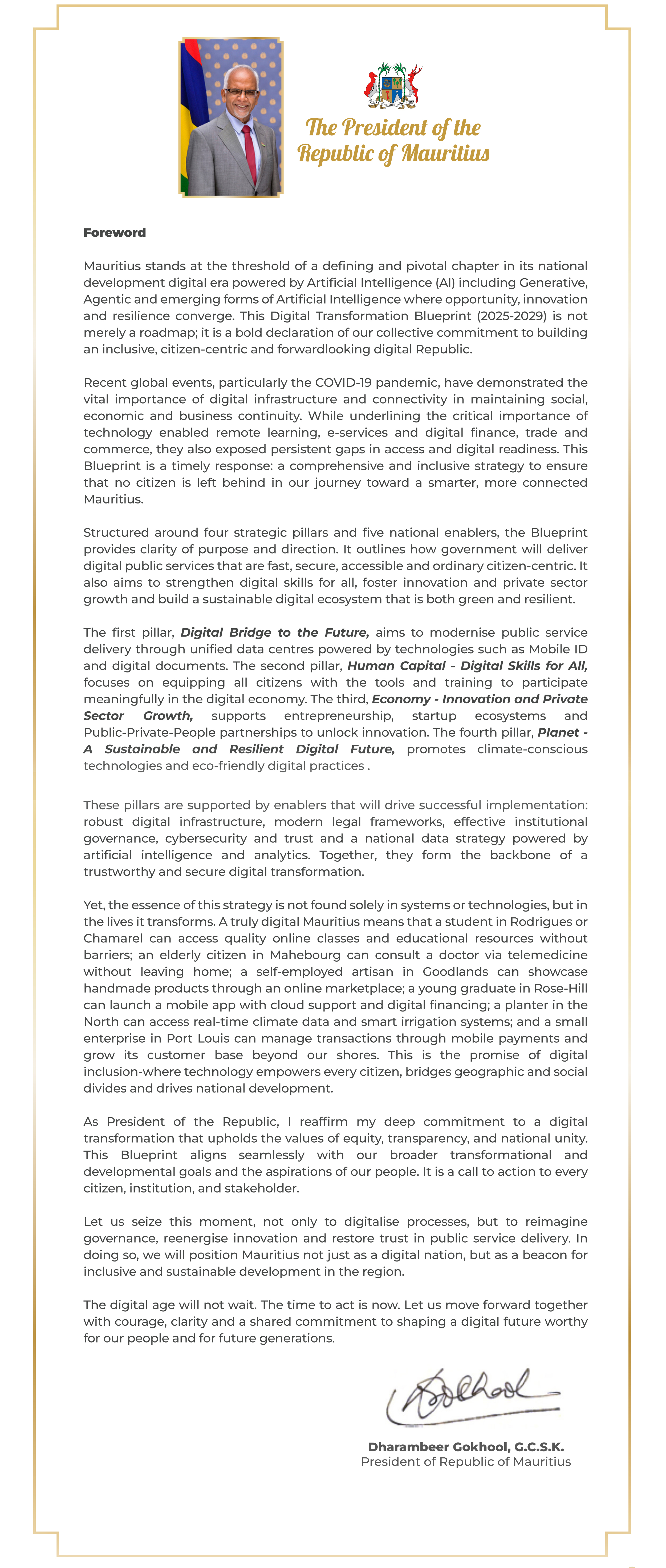
The Blueprint frames digital transformation as a people‑first, inclusive national programme — not just a technology upgrade.
President of the Republic of Mauritius
Dharambeer Gokhool, G.C.S.K.
Key message
Prime Minister, Republic of Mauritius
Dr the Hon Navinchandra Ramgoolam, GCSK, FRCP
Key message
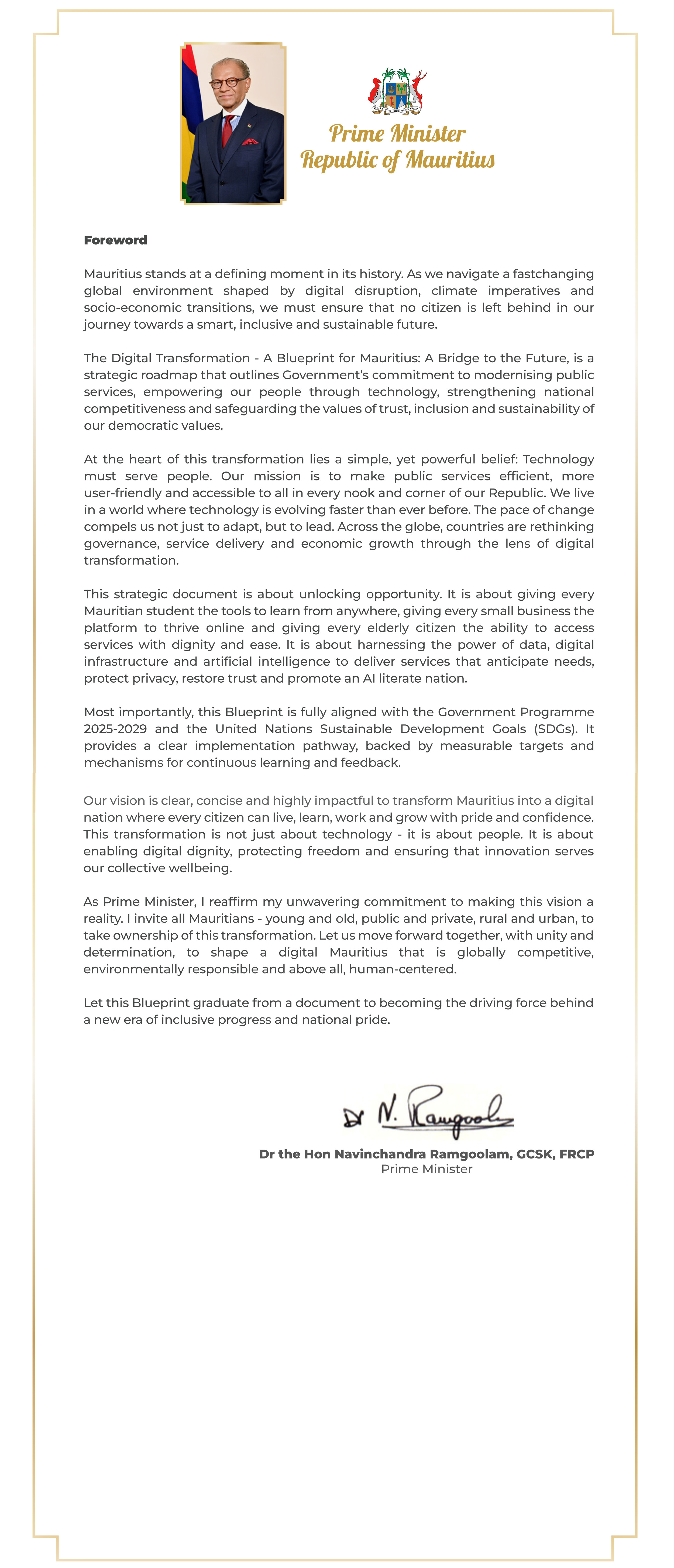
Minister of Information Technology, Communication and Innovation
Dr the Hon Avinash Ramtohul
Key message
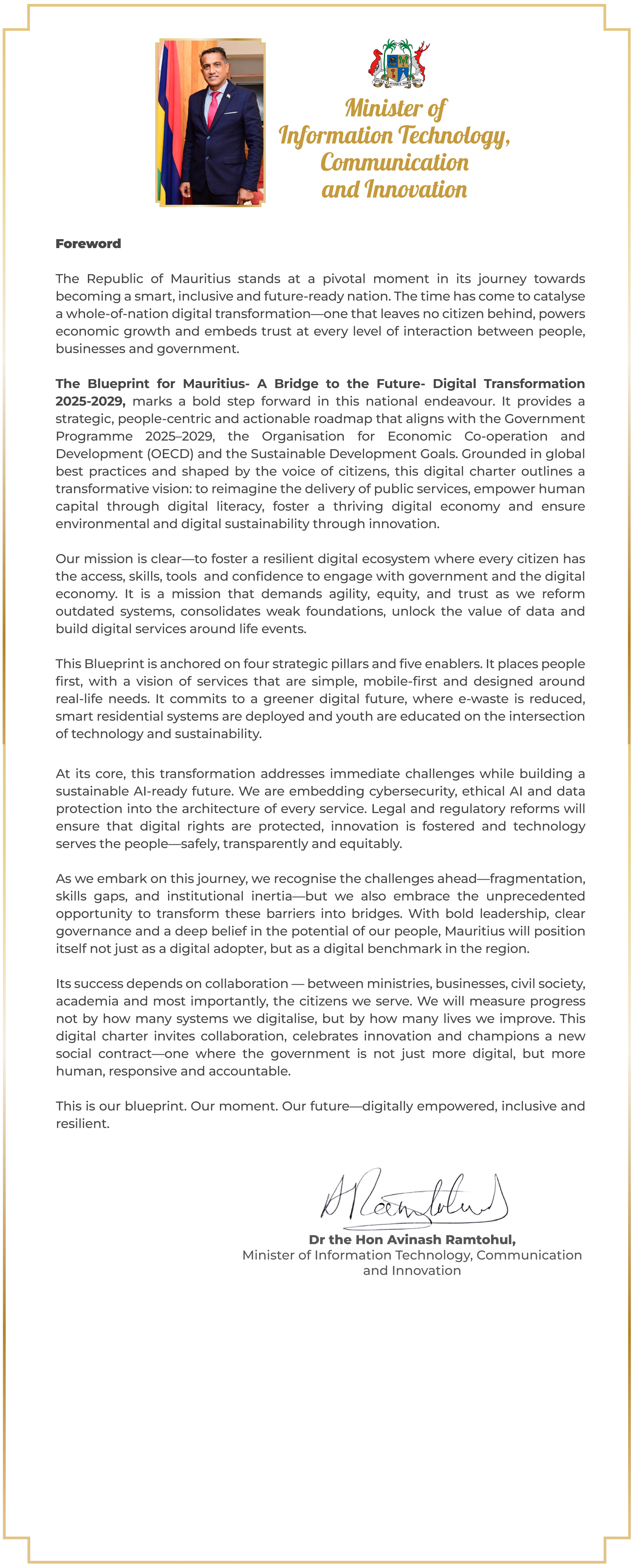
UNDP Resident Representative, Mauritius and Seychelles
Amanda K Serumaga
Key message
Executive summary
Government is entering a decisive phase in its digital transformation
journey with strong ICT infrastructure, expanding digital platforms,
and growing public demand for better services.
The Digital Transformation Blueprint (2025–2029) sets out a clear
roadmap to transform public service delivery, bridge the digital
divide, enable inclusive economic growth and secure digital trust, all
the while building a greener and more resilient society. Beyond
mere efficiency, this approach asserts that digital government
should also be inclusive, trusted and focused on the citizens.
This strategy draws on global best practices, insights from local
consultations and the real experiences of citizens and businesses
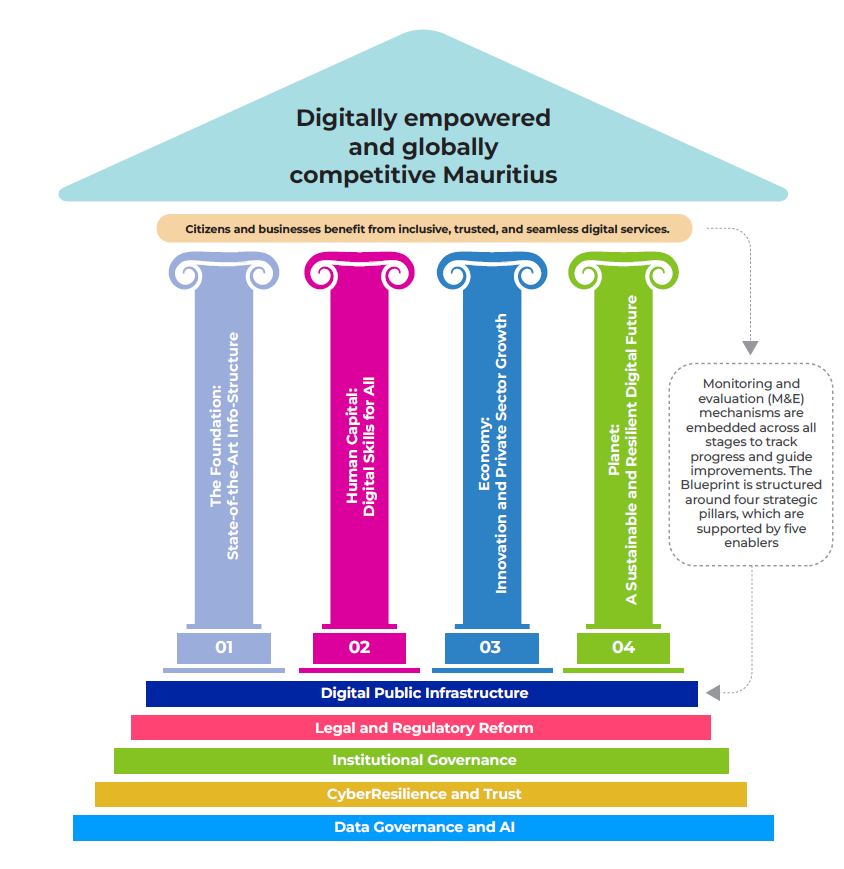
Blueprint structure
Four strategic pillars
Blueprint structure
Supported by five national enablers.
GOVERNMENT PROGRAMME 2025-2029
Each pillar and enabler outlined in this Blueprint, is directly aligned with the
commitments set out in the Government Programme 2025-2029. This alignment
ensures that the country’s digital transformation efforts are fully integrated into our
broader national development agenda.
Through this Blueprint, Mauritius will harness the power of digital technologies to build
a more inclusive, democratic and sustainable society. By strengthening digital
infrastructure, enhancing digital skills, fostering innovation, and promoting trust in the
digital ecosystem, this document aims to position Mauritius as a leading digital
economy - one that leaves no citizen behind and drives future growth for all.
The Architecture for Change
Sustainable Development Goals
The strategic pillars and enablers of the Digital Transformation Blueprint are closely aligned with the Government's Programme and UN Sustainable Development Goals (SDGs), supporting inclusive growth, innovation, resilience and environmental sustainability.
Vision & strategic objectives
A clear national direction for a thriving, smart, and inclusive digital society.
Vision
Transform Mauritius into a thriving, smart and inclusive digital society.
Mission
To foster a conducive and resilient digital ecosystem for the empowerment of people and businesses.
Values
- Excellence — high standards in service delivery and innovation.
- Innovation — creativity and technological advancement.
- Integrity — transparency, accountability, ethics.
- Adaptability — embrace emerging trends.
- Efficiency — streamline services and productivity.
Strategic objectives (expand)
- Enable digital transformation via proactive policies and legislation for G2G, G2B, G2C.
- Accelerate infostructure growth aligned with international best practices.
- Bridge the digital divide through inclusion and access for all.
- Advance ICT/AI powered services that are trusted, secure, and resilient.
- Build digital skills through education, training, reskilling and upskilling.
- Promote data protection and privacy, and ethical use of digital services.
- Ensure universal access to high‑quality, secure, cost‑efficient communications.
- Internationalisation: position Mauritius globally in innovative digital services.
Digital readiness & context
Strong connectivity is a foundation — but citizens also need coordinated, user‑centric services that are simpler to access and easy to trust.
Strengths to build on
- Five submarine cables
- ~99% fibre‑to‑the‑home coverage
- Mobile penetration above 175%
- Tier 1 in Global Cybersecurity Index; #1 in Africa for readiness
- Mobile ID / Digital ID and intra‑government data sharing launched
People’s voice (themes)
- Mobile‑first services that work end‑to‑end (not only at an office).
- Stop requesting the same document repeatedly (once‑only / “tell‑us‑once”).
- Clearer communication on how personal data is used, shared and protected.
- More services and support content in Kreol.
- Simpler user journeys with proactive status updates and notifications.
Challenges to address
- Fragmented systems and weak interoperability between ministries
- Uneven trust, awareness and digital literacy uptake
- Skills shortages (cybersecurity, AI, service design)
- Network Readiness Rank: 60 (global); e‑Government Rank: 76
Bridging the last mile
The Blueprint prioritises quick wins, capability building, better coordination, and continuous listening and improvement.
Four strategic pillars
Each pillar includes: the challenge, the priority, and concrete actions — presented as expandable cards for easy browsing.
The Foundation — State‑of‑the‑Art Info‑Structure
Move citizens from being in line to being online with life‑event‑based, unified digital services.
The challenge
People are tired of queuing up because services remain centered around siloed functions instead of life events.
Our priority
Put people first — redesign services around “Whole‑of‑Life” events (starting a family, launching a business, retiring), enabled by a whole‑of‑government approach.
Actions under Pillar 1 (expand)
Unified portal & Government Super App
All services under one roof with one login via Digital ID/Mobile ID.
National Digital Services Framework
Digital‑by‑default, once‑only, life‑event journeys, mobile‑first, clear service standards.
Services built around life events
Pre‑filled forms with consent, proactive reminders, secure data flow across government.
Digital identity & documents
Mobile ID for identity, signing documents, and secure access to services.
Smart credentials
Mobile driving licence, digital birth certificate, and secure identity verification.
Digital health
Appointments, prescriptions, and selective sharing of health records with doctors.
Digital education (including AI)
Digital learning platform for students, civil service and the public; parent visibility.
Digital social support
Apply online for pensions/allowances; real‑time updates; support to bereaved families.
eJudiciary
Extend eJudiciary for online case consultation, files and payments.
e‑Participation
National platform for consultations, policy feedback, participatory budgeting.
Digital transport
Renew driver’s licence, register vehicles, pay MVL, and receive transport alerts on mobile.
Digital immigration
Integrated digital visa, border processing, travel checks; e‑passport for citizens.
Lespwar App & DOVIS upgrade
Faster emergency alerts, privacy, geolocation; revamped domestic violence case management.
Digital commerce & e‑procurement
E‑commerce regulation to protect consumers; revamped e‑procurement end‑to‑end.
Digital agriculture & Digital Twin Mauritius
IoT + AI for productivity; virtual Mauritius for planning and resilient infrastructure.
Safety systems
Cell Broadcast System for targeted alerts; upgraded Vessel Monitoring System.
Your experience reimagined
- Less paperwork — move from being in line to being online.
- Submit credentials and documents once only.
- Proactive notifications and safety alerts.
- Omni‑channel access from home, at your pace.
- A government that is citizen‑centric and caring.
Human Capital — Digital Skills for All
Empower every person to confidently use digital public services and participate in the digital economy.
The challenge
Significant segments of the population lack the skills and support needed to benefit from digital services.
Our priority
Equip citizens with tools, training, and assisted access so no one is left behind.
Actions under Pillar 2 (expand)
National Digital Literacy Campaign
Train citizens to use digital services safely and confidently, prioritising vulnerable groups.
Digital Leadership Training
Mandatory training for public officials to champion transformation across ministries.
Build digital talent across public service
Reskilling/upskilling in cybersecurity, AI, data, cloud, blockchain, and service design.
Assisted Digital Access Scheme
Helpdesks and mobile digital labs (with internet/VR capabilities) to reach localities.
Inclusive training, reskilling & upskilling
Targeted programmes including gender equity initiatives (e.g., Women in Tech bootcamps).
Your experience reimagined
Self‑paced modules on mobile phones, personalised learning, and hands‑on help in local communities — so students, jobseekers, parents and pensioners can go digital at their own pace.
Economy — Driving Innovation and Private Sector Growth
Help SMEs and startups scale, attract tech investment, and unlock public‑private‑people innovation.
The challenge
Limitations in digital innovation, tech investment and SME digitalisation hinder scalability and export readiness.
Our priority
Stimulate entrepreneurship and a thriving ecosystem through targeted programmes, partnerships and open innovation.
Actions under Pillar 3 (expand)
Smart industry & digital trade
Automation, AI, and digital twins across sectors; integrate trade gateways into a single window.
Helping small businesses go digital
Practical tools for SMEs, outreach to women‑led/youth‑led/informal businesses; digital “cités des métiers”.
Strong innovation ecosystem
Expand tech hubs, strengthen innovation funds, run hackathons, and turn research into startups.
Public‑Private‑People partnerships (4P)
Open platforms/data and launch national challenges to crowdsource solutions.
Global readiness & inclusive innovation
Modernise geolocation, delivery and e‑commerce; support internationalisation via accelerators and soft‑landing hubs.
Digital diplomacy
Deepen global partnerships and leverage diaspora for capacity‑building and access to frontier technologies.
DR hosting in Mauritius
Position Mauritius as a secure destination for regional disaster recovery data centres.
Cross‑border data exchange for trade
Enable Electronic Transferable Records and explore blockchain frameworks aligned with UNCITRAL model laws.
Empowering startups & technopreneurs
Incentives, IP protection, market reach through G2G channels and EDB programmes.
Digital is an ecosystem
The Blueprint positions Digital Public Infrastructure, cybersecurity, AI regulation, talent programmes and open data as the foundation for a regional tech hub and sustainable private‑sector growth.
Planet — Building a Sustainable and Resilient Digital Future
Green digital infrastructure, circular digital practices, and climate‑conscious innovation.
The challenge
Digital growth can increase e‑waste and energy consumption if sustainability is not built in.
Our priority
Make every system, service and digital habit support climate action and reduce environmental impact.
Actions under Pillar 4 (expand)
Greener government services
Lightweight portals, eco‑friendly hosting, green computing, data minimisation and accessibility.
Circular digital economy & waste reduction
E‑waste recycling frameworks, green procurement, green data centres, and device refurbishment.
eCabinet
Paperless cabinet operations with strong authentication, encryption and digital signatures.
Green skills, education & innovation
Green ICT curriculum, sustainability hackathons, and awareness campaigns on digital minimalism.
Smart island, clean energy & green IoT
Smart lighting/traffic, digital twin planning, explore ETS, green transport tools, IoT hazard monitoring.
Your experience reimagined
Cleaner, greener, smarter daily digital services — less paper, more energy‑efficient systems, and smarter planning for healthier communities.
Five national enablers
The enablers are the delivery backbone: shared digital foundations, laws, institutions, cybersecurity and trusted data/AI.
Digital Public Infrastructure
Build a resilient GovStack (identity, data sharing, payments, trust services) to deliver end‑to‑end G2X services.
The challenge
Foundational blocks are missing or not interoperable; GovStack and legal sanctity for online identity are needed.
Our priority
Establish an open‑architecture GovStack and DPI inspired by international examples (API‑driven shared components).
What powers the digital nation? (expand)
One identity
Single sign‑on via a National Identity Management Framework; digital signatures for secure signing.
Your data — connected, under your control
Citizen Data Hub as a secure “single source of truth”, connected via InfoHighway.
Government cloud & data centres
Sovereign cloud with disaster recovery for resilience of critical infrastructure.
Building for speed and innovation
Micro‑services platforms and shared components (e.g., payment gateway) to reduce duplication.
Legal and Regulatory Reform
Modern laws to protect rights, enable innovation, and give legal recognition to digital services and identities.
The challenge
Emerging technologies and online risks require updated legal frameworks for privacy, resilience and digital trust.
Our priority
Align laws with technological advances, protect citizen data, and reinforce confidence in digital services.
Key legal actions (expand)
Update Data Protection Act (2017)
Realign with GDPR, enable e‑privacy regulations and data protection officer frameworks.
Freedom of Information
Enact FOI and revise constitutional privacy rights to include data protection and FOI.
Cybersecurity & Cybercrime Act review
Add child online protection, auditing firm listing, and establish the NCRCSA.
Electronic Transactions Act (2000)
Amend for domestic and international e‑transactions aligned with UNCITRAL model laws.
Telecom regulation modernisation
New licensing framework, open access policy expansion, cybersecurity directive for operators.
Other regulatory measures
Accounting separation framework, and regulation for NGSO broadband internet services.
Institutional Coordination and Governance
Clear roles, agile delivery capacity, and empowered institutions to execute digital transformation.
The challenge
Weak coordination and unclear roles create delays and inconsistent service delivery.
Our priority
Build strong institutions to lead, support and deliver — with accountability for results.
What changes institutionally? (expand)
- Establish a National Digital Transformation Bureau (NDTB) to drive execution (GovTech‑style delivery).
- Create a Data Management Unit evolving into a Data Management Office (DMO) to lead data strategy and ethics.
- Strengthen a national cybersecurity entity (NCRCSA) to oversee resilience and digital trust services.
- Set up or reinforce supporting bodies for promotion, emerging tech, and operational support.
Cybersecurity and Trust
A secure digital space for citizens, businesses and government — with prevention, readiness and rapid response.
The challenge
Online services increase exposure to cyber threats, breaches, and harmful content.
Our priority
Roll out trustworthy services through national focus on cybersecurity, data protection and online safety.
Cyber actions (expand)
National cyber strategy
Adopt a Cyber Resilience and Cybersecurity Strategy aligned with international standards.
Strengthening readiness
Regular cyber drills to build skills, coordination and rapid response.
Critical Information Infrastructure
Enforce a framework to safeguard vital sector systems (health, energy, finance, transport, etc.).
Threat detection and response
Operational SOC, cyber threat information sharing, and AI lexicon for harmful content detection.
Trust infrastructure
Upgrade Certification Authority for secure e‑signatures, timestamping and approvals.
Child online protection & awareness
Comprehensive child online protection framework, cyber awareness initiatives and guidance on moderation.
Data Governance and Artificial Intelligence
Treat data as a national asset and embed trustworthy AI to improve services and policy‑making.
The challenge
Government data is fragmented and duplicated, limiting responsive services and secure sharing.
Our priority
Create a single source of truth via a Citizen Data Hub managed by DMO, with strong governance and ethics.
Data + AI actions (expand)
National Data Strategy (2025–2030)
Data quality, ethical use, a world‑class data economy, strong privacy safeguards, AI readiness.
Tell‑Us‑Once policy
Once a citizen shares a document, connected agencies must reuse it via InfoHighway.
Open data & Freedom of Information
Release open data through a modernised portal and train ministries in open data management.
National AI Strategy
Establish an AI Unit; embed a human‑centric, trustworthy, ethical AI policy (transparency, fairness, accountability).
AI for public value
Automation, virtual assistants, predictive analytics (e.g., AI‑powered job match), and climate/urban planning.
AI ecosystem
Regulatory sandboxes, Fab Labs, PPP initiatives such as an AI Tech Park for R&D and startups.
Your experience reimagined
AI‑enabled services aim to make interactions smoother — from 24/7 virtual assistants to more responsive health, education and social services, with strong safeguards and ethics.
Governance, monitoring & implementation
The Blueprint includes a governance and monitoring framework with measurable progress, efficient delivery, and feedback‑driven improvement.
How progress is tracked
- Measurable progress — tracked with clear, verifiable data.
- Efficient delivery — proactive removal of obstacles.
- Responsive improvement — continuous citizen feedback.
The M&E framework is aligned with OECD digital government maturity dimensions, the UN SDGs, and SMART indicators.
Six key themes — one scorecard
Implementation steering
A National Digital Transformation Steering Committee oversees implementation, supported by workgroups across public sector, industry, academia and ICT leadership.
Final thoughts
The Blueprint is designed to deliver tangible benefits to citizens and businesses — through collaboration, trust, and inclusive design.
What this is about
Moving from siloed data and processes to a unified GovStack and Digital Public Infrastructure to realise next‑gen Mauritius — a government that is accessible, trustworthy and caring.
What it requires
Strong collaboration across Government, private sector, education, civil society and citizens — ensuring services are inclusive, safe, and built around real life.